

A tour departure or yoga class is not a stack of private appointments at the same time. It is one dated occurrence with a finite number of participant places, several purchasing parties and an operational team that may need a specific boat, van or studio. WelaOS connects that group flow from a customer's LINE booking to the occurrence roster, staff/resource confirmation and a separate POS checkout for each customer booking.
A group booking has two kinds of capacity
Imagine Andaman Day Trips, a fictional operator selling a Sunset Boat Tour. Ten guests can join Tuesday's departure, but the operator has only one eligible boat. Those numbers answer different questions.
- Participant capacity answers: how many people can customers reserve on this specific departure?
- Resource capacity answers: how many overlapping sessions can use this operational asset?
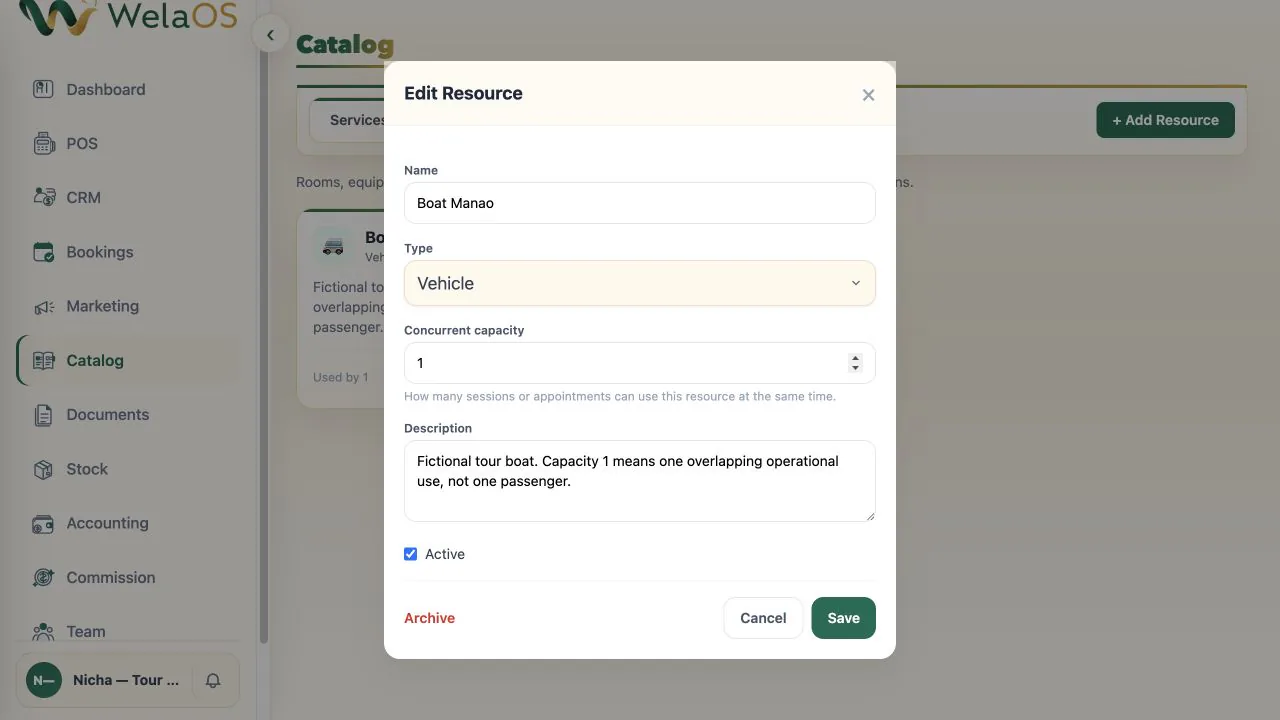
For this example, the Group service has ten participant places. The Resource called Boat Manao has concurrent-use capacity one. That does not mean the boat carries one passenger. It means staff cannot lock the same boat to two overlapping departures.
1. The customer reserves places on a dated occurrence in LINE
Group services are available to the business types that normally sell classes, tours, trips or instruction, including Tour / travel and Fitness / yoga. Staff create the Sunset Boat Tour as a Group service, set its per-participant price, duration, supported recurrence and participant capacity, and assign the eligible staff and resource pools.
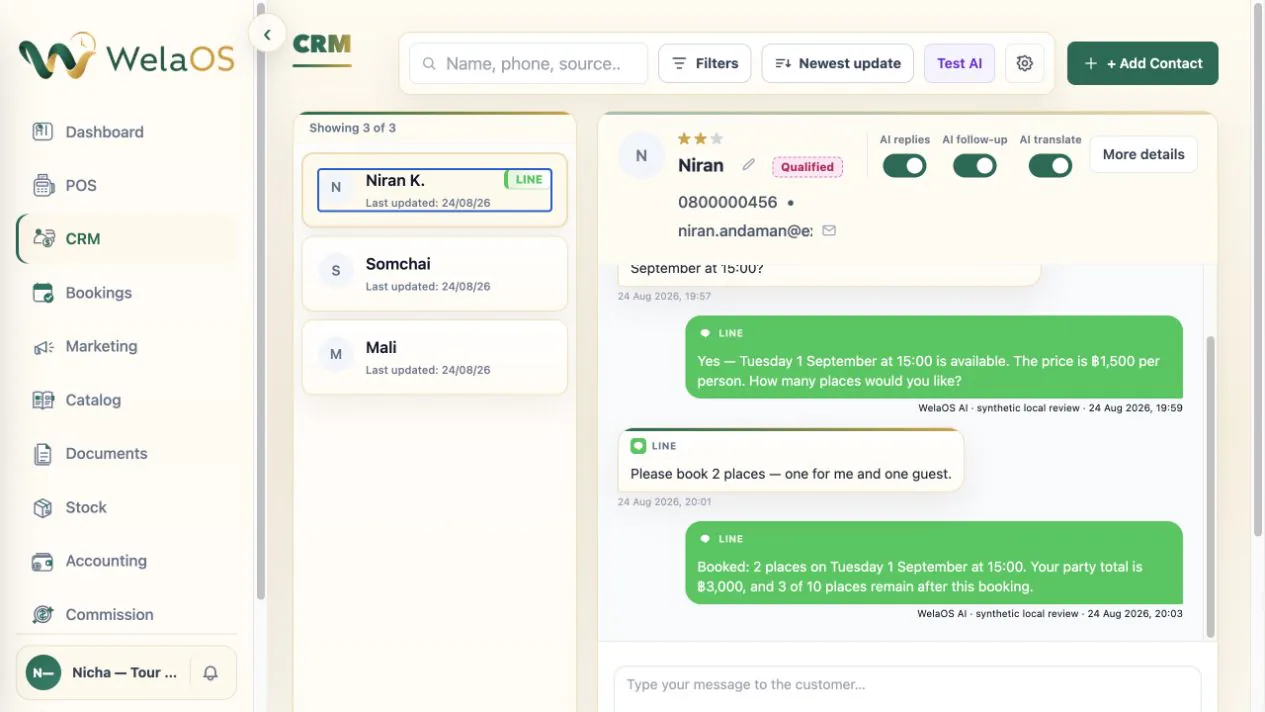
When Niran asks to book for two people, the optional AI assistant can recognise the named service and booking intent. The actual service, price and booking availability still come from the current Catalog and Bookings data. The deterministic group flow then shows upcoming occurrences with remaining places.
- Customer
Is the Sunset Boat Tour available on Tuesday 1 September at 15:00? - WelaOS
Yes, Tuesday 1 September at 15:00 is available. The price is ฿1,500 per person. How many places would you like? - Customer
Please book 2 places, one for me and one guest. - WelaOS
Booked: 2 places on Tuesday 1 September at 15:00. Your party total is ฿3,000, and 3 of 10 places remain after this booking.

One Booking row represents Niran's purchasing party with a participant count of two. At ฿1,500 per person, the saved booking total is ฿3,000. Once those two places are reserved, the occurrence moves from five to seven of ten places filled.
The capacity check is transactional. If two customers try to reserve the final places at the same moment, WelaOS locks and rechecks the occurrence before creating the booking. A request that would exceed the remaining capacity is rejected rather than quietly overselling the departure.
2. Different services create different dates without overlapping customer cards
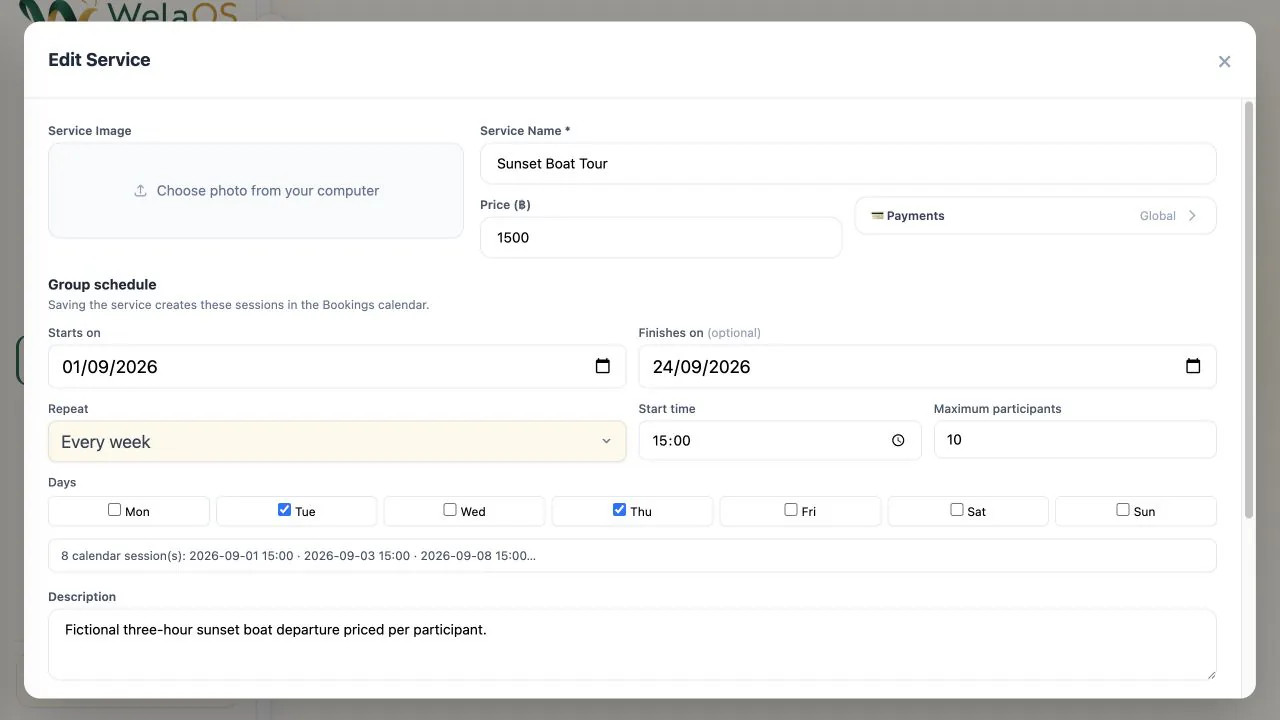
A group operator does not need to recreate each departure by hand. Each sellable experience is its own Group service with one supported series definition. A one-time event can have one date; a recurring service can run weekly or every two weeks on selected weekdays between its configured start and optional finish date.
| Fictional Group service | Occurrence pattern | Participant capacity | Eligible operational resource |
|---|---|---|---|
| Sunset Boat Tour | Tuesday and Thursday at 3:00 pm | 10 people per departure | Boat Manao or another eligible boat |
| Old Town Minibus Tour | Wednesday and Saturday at 9:00 am | 8 people per departure | Van 1 or another eligible vehicle |
| Morning Flow Yoga | Monday, Wednesday and Friday at 8:00 am | 14 people per class | Studio A or another eligible studio |
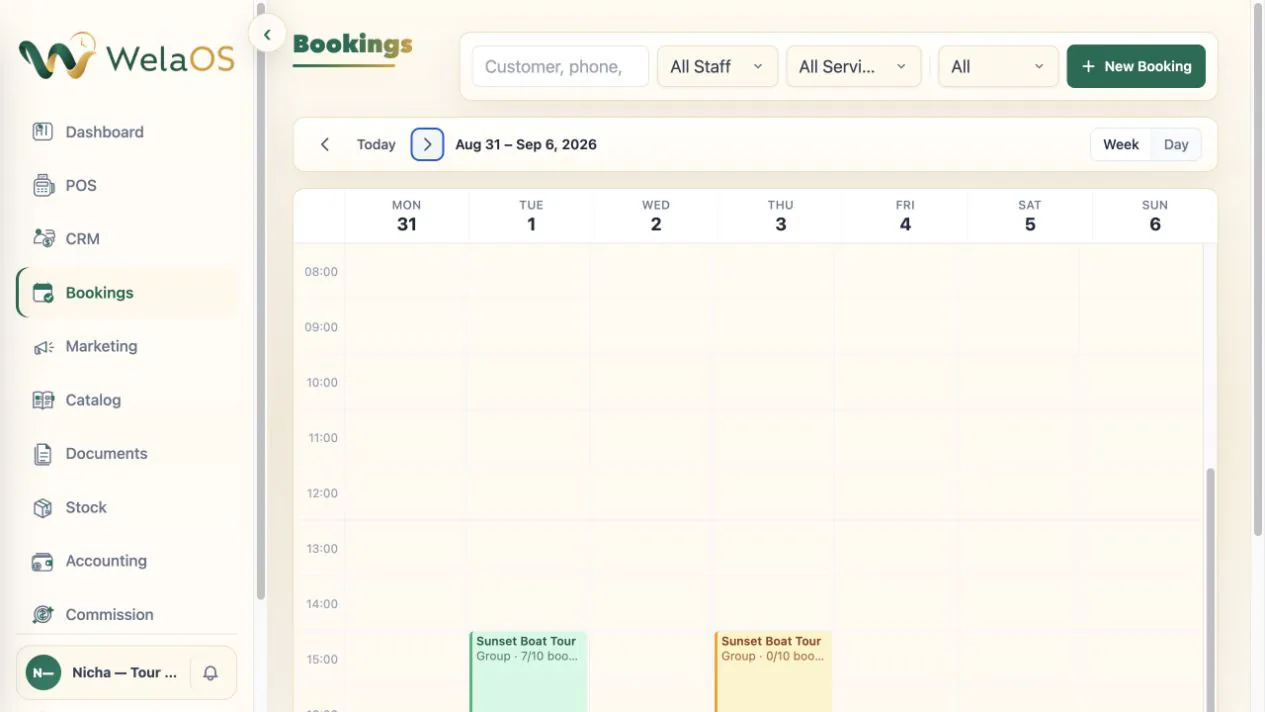
Saving the service creates or reconciles the future dated occurrences in the Bookings calendar. A customer who chooses Sunset Boat Tour sees its upcoming departures; a yoga customer sees Morning Flow Yoga sessions. They are not asked to select an arbitrary private time that happens to overlap everybody else.
In the calendar, one occurrence appears as one block labelled with its reserved/capacity total. Ten customer places do not create ten overlapping calendar cards. Opening the block reveals the roster.
3. The roster manages purchasing parties, not an invented passenger manifest
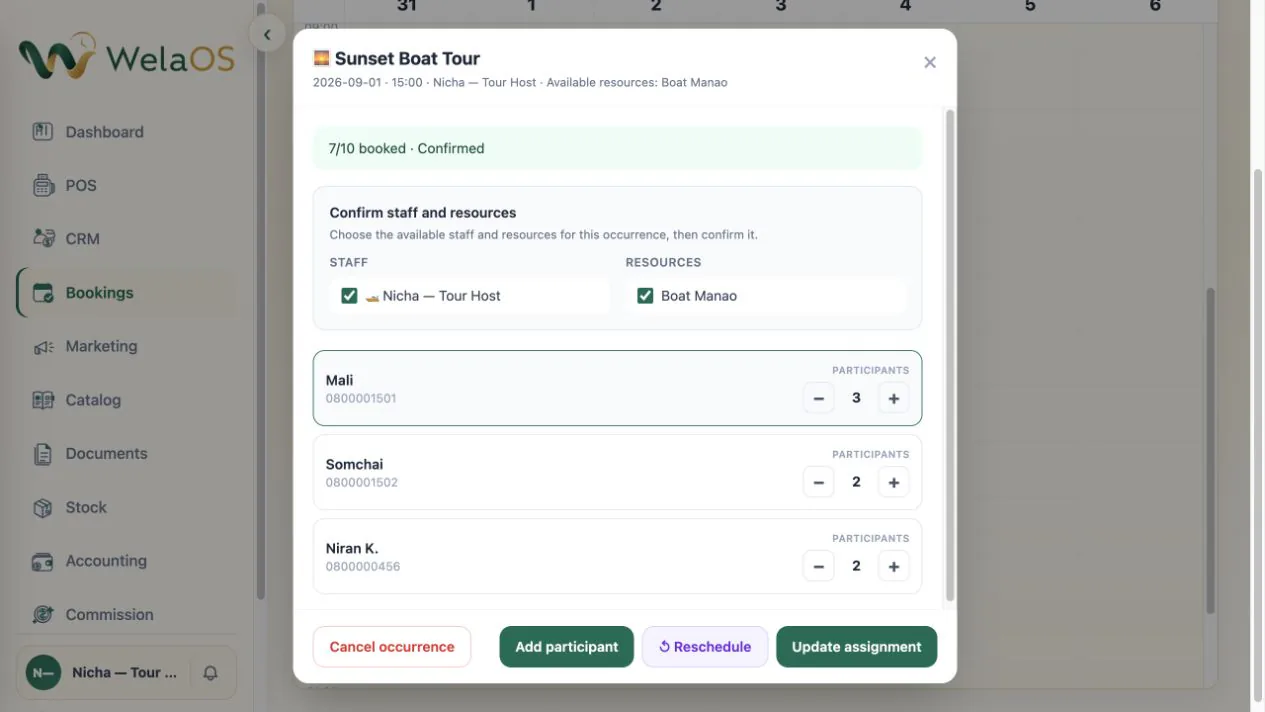
Tuesday's fictional roster might contain Niran ×2, Mali ×3 and Somchai ×2. That is seven participant places across three purchasing parties. Staff can add a party from the occurrence, increase or decrease a party's count within the remaining capacity, remove a party, or move one party to another occurrence for the same service when enough places remain.
Reducing or removing a party returns places immediately, so the available count can be offered again. Moving the whole occurrence moves all active parties with it; moving one party from the roster changes only that customer's booking.
The boundary matters. The current roster records the purchasing customer and party size. It is not a per-seat manifest with a named profile, passport, waiver and seat assignment for every unnamed participant. An operator that legally requires those individual records should not assume the party count replaces that separate process.
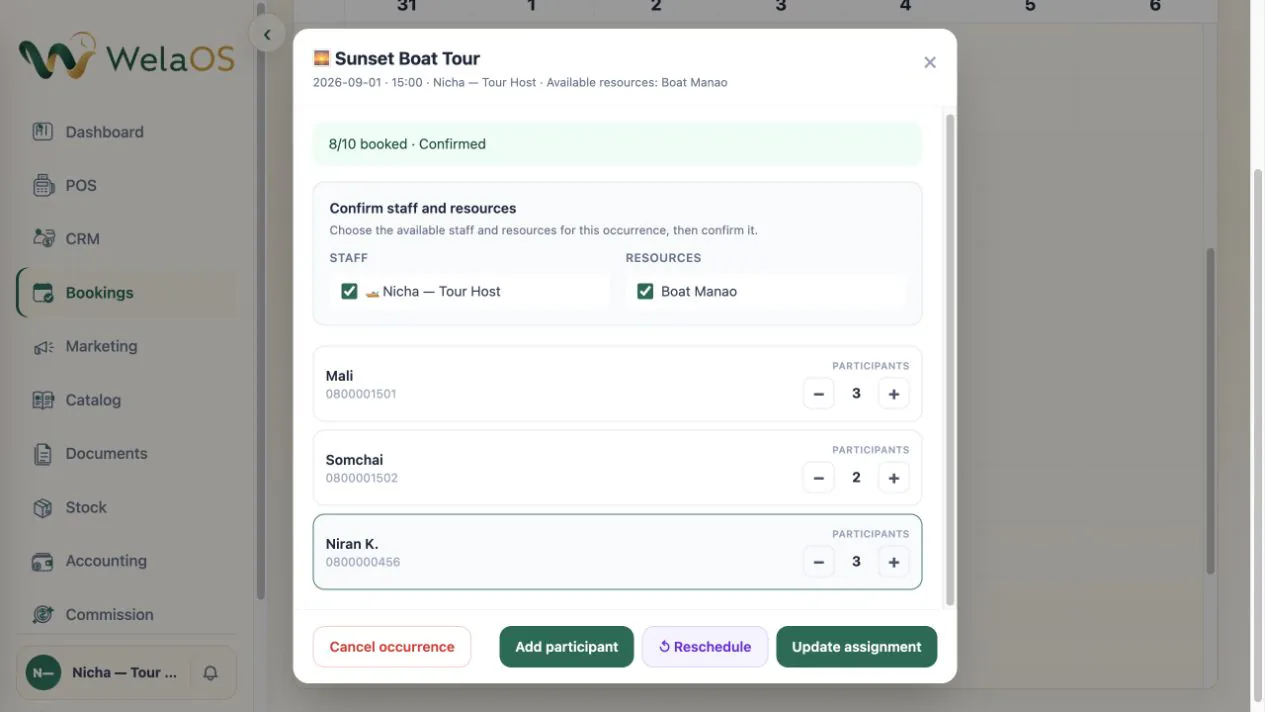
4. Staff lock the host and boat or van before confirming the occurrence
The customer-facing capacity says whether places remain. Operations still needs to know whether the session can be fulfilled. Catalog Resources can represent rooms, equipment, vehicles, studios, boats and other shared constraints. A service defines its eligible staff and resource pools; the dated occurrence is where staff choose and lock the people and assets that will actually run it.
For Tuesday's Sunset Boat Tour, staff select Nicha, Tour Host and Boat Manao, then confirm the occurrence. WelaOS validates the staff rota, time off, overlapping booking/session conflicts and the chosen resource's concurrent-use capacity. If Boat Manao is already at capacity for an overlapping charter, confirmation is rejected until staff resolve the assignment. The system does not expose that internal asset decision as a customer choice.
Once the occurrence is confirmed, active participant bookings are confirmed and the shared booking notification path sends the update to each lead customer. A later customer joining an already confirmed occurrence inherits that confirmation, subject to the remaining-place check.
5. POS closes one purchasing party at a time
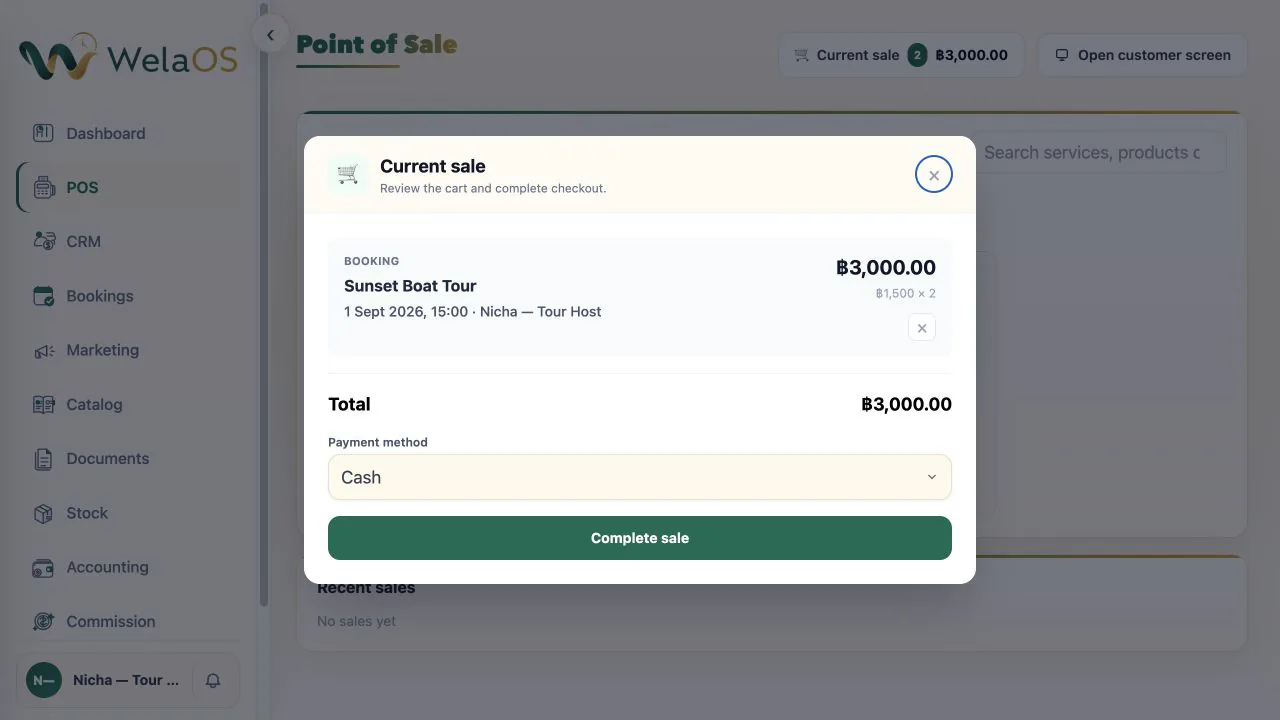
After the tour, staff can open POS and select Niran's eligible booking. Current sale shows the booked Sunset Boat Tour line with quantity two and the saved total of ฿3,000. Staff review the sale, take the chosen supported payment method and complete checkout. The completed sale closes that booking through the standard POS path and makes its receipt available.
The occurrence may contain several parties, but it is not one customer. Mali's three-place booking and Somchai's two-place booking stay separate customer checkouts. WelaOS does not combine the entire roster into one aggregate POS payment, which keeps customer history, payment and receipt attribution unambiguous.
This example deliberately uses no booking deposit, so the full amount is collected in POS. A business may instead configure the supported deposit or full-payment booking rules for a service. Tour-specific refunds, settlement and group payment are separate processes and are not implied by this checkout.
The same pattern works for a yoga studio
A yoga studio can apply the same shipped model without pretending a class is a private appointment. Morning Flow Yoga is a Group service. Its Monday, Wednesday and Friday sessions each have their own fourteen-person capacity. Customers in LINE choose a dated class and party size. Staff see one class block and its roster, then lock the instructor and Studio A before confirming the occurrence.
The studio still keeps the two capacity questions separate: fourteen participant places are sellable, while Studio A with concurrent-use capacity one cannot host an overlapping class. After attendance, POS handles each customer booking separately.
Define one real occurrence before importing the whole timetable
A useful setup starts with operational truth, not the largest possible service list:
- Create a separate Group service for each experience or class customers can actually choose.
- Set the price per participant, duration, supported recurrence and honest participant capacity.
- Assign only staff and Resources that can fulfil that service; treat Resource capacity as concurrent use, not passenger places.
- Decide whether participant requests stay pending until staff confirm the occurrence, and configure any current booking-payment rule deliberately.
- Decide whether one purchaser plus party size is enough for operations or whether a separate regulated passenger/attendee manifest is required.
- Agree that reception closes one purchasing party's booking per POS sale.
Start with one departure and test the full handoff: a customer reserves two places in LINE, the roster fill changes, staff lock the real asset, confirmation reaches the customer, and that party reaches POS after the session. Once that works, add the next service and its own dates.
Group booking software should make the departure clearer
For an operator comparing tour booking and capacity management software, the strongest workflow is not the one with the most calendar cards. It is the one where customers see the right occurrence and remaining places, operations sees the true roster and asset conflicts, and finance closes each customer booking accurately.
Explore the WelaOS growth loop to see how the enquiry and checkout connect to the wider customer journey. You can also browse other service-business use cases or compare WelaOS plans.